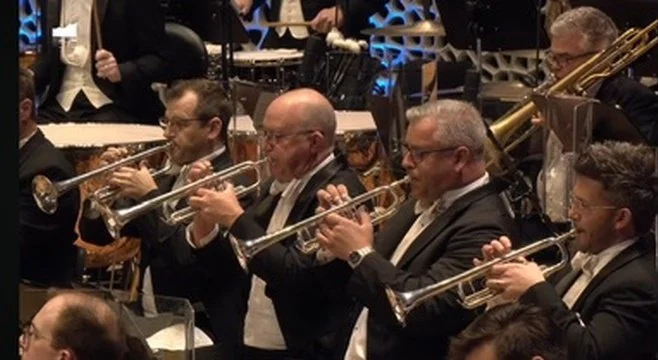
The Pittsburgh Symphony trumpet section performing on the 2026 European tour
Greetings, All! I’m writing this from a hotel room somewhere between Lucerne, Switzerland and Cologne, Germany. The Pittsburgh Symphony is in the middle of a European tour: 13 concerts in 16 days, nine cities, six countries. Salzburg, Warsaw, Hamburg, Lucerne, Vienna. Some of the most famous concert halls in the world, back to back, with a plane or a bus ride in between.
Almost every trumpet student I teach eventually asks some version of the same question: how do professionals do it? How do you play your best night after night, in a different hall every time, when you’re tired and jet-lagged and the programs haven’t changed in three weeks?
The honest answer is that nothing about a tour is magic. It’s the same handful of habits I ask my students to build, just with the stakes turned all the way up. Here’s what three weeks on the road has reminded me.
The warm-up routine is not optional. Ever.
On tour, the only thing that stays the same for me is the first twenty minutes of my day with the horn. Different bed, different time zone, different backstage area, different hall (with sometimes amazingly different acoustics), but the same Cichowicz long tones, the same articulation exercises, the same first-notes-of-the-day with high E’s and F’s above high C, in the same order. My routine tells my face and my brain that it’s a normal day, even when it isn’t.
Students often treat warming up as something you do when there’s time. I treat it as the thing that makes time. I don’t ever skip it for any reason, ever. If you’re going to keep one habit this fall, keep this one.
Consistency beats intensity.
We will play Shostakovich’s Fifth Symphony six times on this trip and Dvořák’s “New World” Symphony seven. Nobody in the orchestra is practicing those pieces for three hours a day right now. That would be unnecessary and ultimately counter-productive. What I do is short, focused maintenance: tricky spots, exposed entrances, the big moments. 30 to 45 minutes, done well, every day.
That’s exactly the model I want for a student in marching season or with a PMEA solo in front of them. Not the heroic Saturday practice session. The unglamorous daily practice session.
Play the room.
Every hall is different. The Elbphilharmonie in Hamburg is bright and immediate. The Concertgebouw in Amsterdam blooms: you play a note and it seems to keep going. The Grosses Festspielhaus in Salzburg is an amazing space where the orchestra sounds huge. If I played every hall the same way, I’d be too loud in one and just right in another.
The skill isn’t memorizing the “right” volume. It’s listening (to the hall, to the principal, to my brass colleagues around me) and adjusting in real time. Young players practice in a bedroom and then are surprised when the band room or the audition room feels different. It always will. Practice listening as much as you practice performing.
Managing energy is part of the job.
There’s a moment on every tour when your body says “enough.” Mine usually comes around the halfway point. I sit onstage and it’s really hot (all of the halls have air-conditioning challenges!), and I’m adjusted to the time change, but the hard part is staying focused, because the music deserves my complete concentration, the rest of the orchestra is playing at an incredibly high level, and the halls are completely sold out.
However, there is a phenomenon I call the “Heinz Hall Effect.” It’s a term I came up with for what happens when the PSO is playing the way it typically does: the orchestra is at such a high level that, on an individual level, it’s actually harder not to play well, no matter how tired I am or what the circumstances are.
But the point is: pros get tired too; we just know how to manage it to never run out of gas. The difference is that we’ve learned to plan for it: sleep when we can, protect the face on off days instead of playing all day, recover in concert by getting the horn off the face as much as possible. Students who learn the difference between tired and hurt, and who treat rest as part of practice, are the ones who stay healthy through a long season. The key indicator: if it’s sore, take it off your face, count to 30 and keep going. If it’s ever a pin-prick? Stop, put it in the case, and “see you tomorrow.”
Nerves never fully go away.
Walking onstage at the Elbphilharmonie, I still feel it. After 20 seasons, I’ve just stopped treating nerves as a problem. Nerves and jitters just mean you care. The goal was never to eliminate them; it was to build a routine (warm-up, relaxed breath, first note) so reliable that the nerves have nothing to grab onto.
If your student is dreading their District audition in October, that’s the message from me: I don’t fix students’ nerves by wishing them away. I manage them by making the first eight bars so automatic that they could play them in their sleep. Here’s how we do that: How to Prepare for PMEA Auditions: A Trumpet Player’s Guide.
Back home on the 11th.
The tour ends in Vienna on September 10, and I’ll be home and teaching again the week of September 14, the same week the fall semester starts at my studio. Everything I’ve written above is what we work on in a lesson: the warm-up that travels with you, the daily practice that actually sticks, listening, endurance, and a routine strong enough to hold up under pressure.
I have a couple of fall spots left for middle and high school trumpet players. If you’d like one, reach out here. The first lesson is free!
Chad Winkler has been a trumpeter with the Pittsburgh Symphony Orchestra since 2006 and teaches middle and high school trumpet students at his studio in Pittsburgh’s South Hills. He also directs the annual Pittsburgh Trumpet Camp each June.
