Low Notes, High Stakes: A Week in the Life of a Second Trumpet Part
Greetings, All!
This past weekend the Pittsburgh Symphony played Prokofiev's Sinfonia Concertante with Alisa Weilerstein on cello and Juraj Valčuha conducting, with Rachmaninoff's Symphony No. 2 after intermission. If you've never heard the Prokofiev, go find a recording. It's forty minutes of Prokofiev at his most Prokofiev; sarcastic one minute, heartbreaking the next, and not easy for anybody on stage (especially the soloist).
I played the second trumpet part for these performances. And here's something interesting for the students reading this: it was my first time playing it. I’ve been playing in professional orchestras since 1998, and there are still pieces I've never touched. This was one of them, and I spent a few weeks getting ready for a part that I may never see again in my career.
But, that's the job. And it's also the lesson.
Second trumpet is not the easy part
There's a myth among young players that first trumpet gets all the fun stuff and second (or third, or fourth) trumpet just “fills in” underneath. The truth is, that almost never happens in the big leagues.
Prokofiev writes the second part of this piece low. In the outer movements it drops to low F# on Bb trumpet - the very bottom of the horn - sometimes at full volume, sometimes at a piano volume. Low and loud is one kind of challenge. Low and soft is a completely different one.
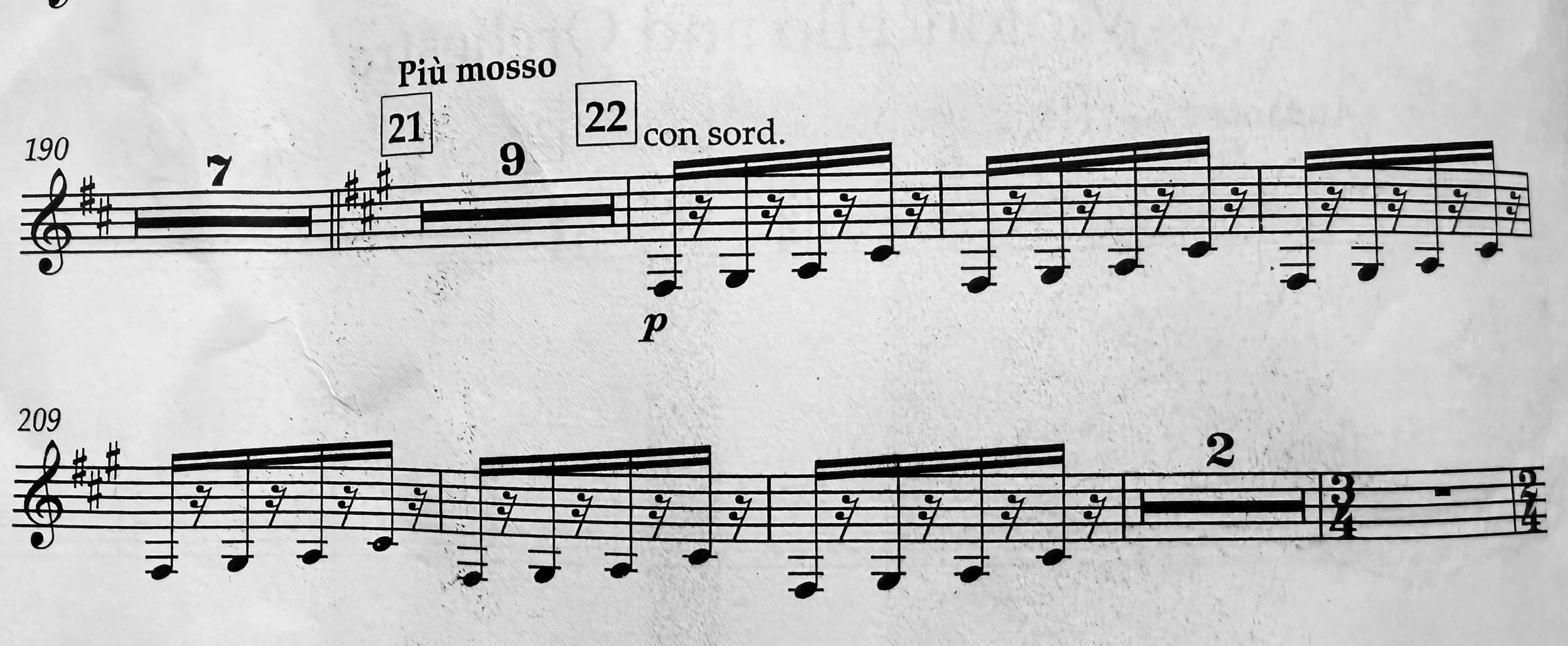
First movement, rehearsal 22. Muted, piano, and a solo.
And then there's the second movement. The strings are playing their pizzicato quietly, the orchestra basically disappears, and there's one very low, very soft note that's mine for several measures. Nobody else. Just a low note that has to sit there, perfectly in tune and perfectly quiet, while a few thousand people listen.
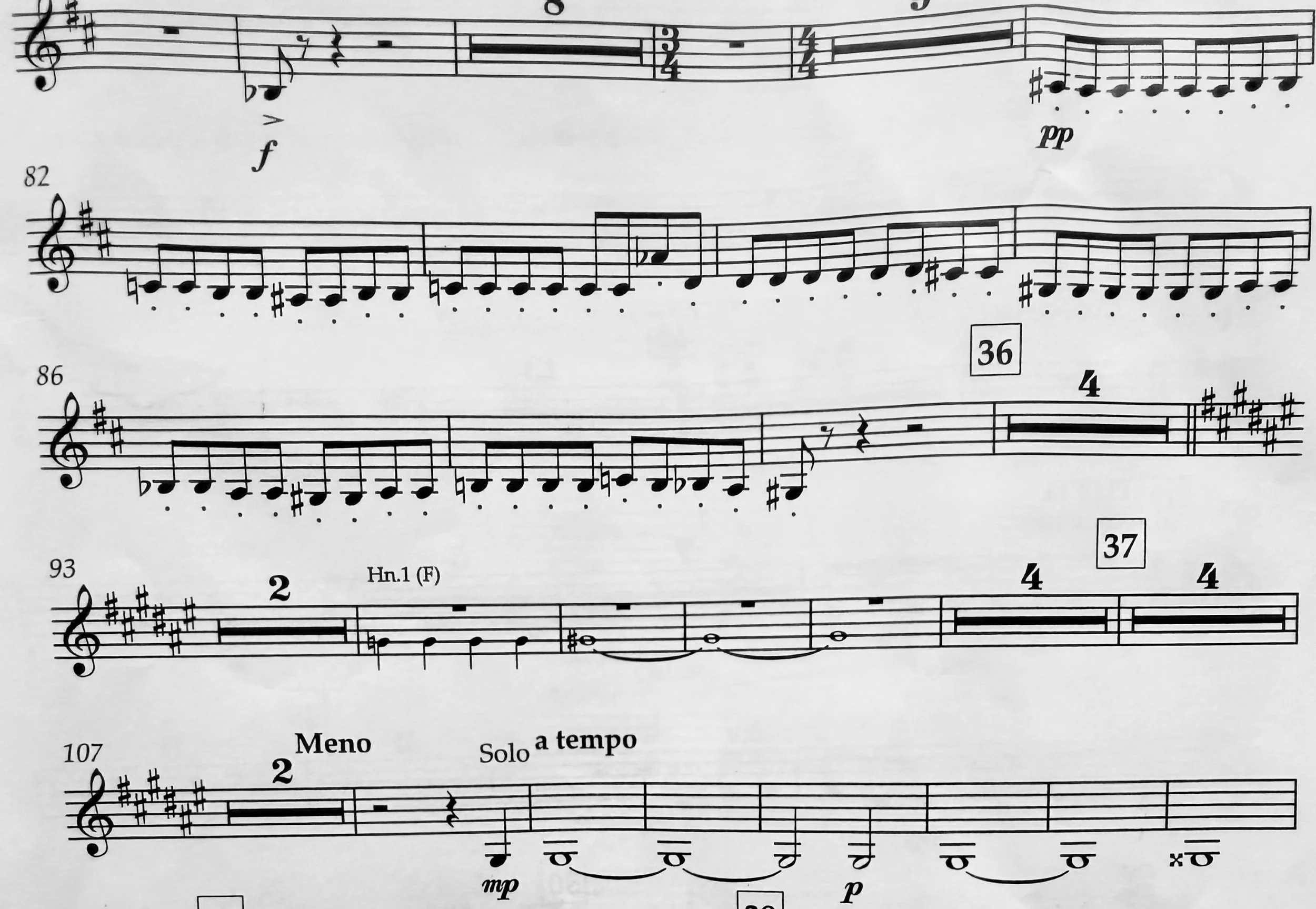
Second movement, from the trumpet part. The soft, articulated low solo at measure 81, and then the long soft solo after measure 107.
Here’s the fun part: Prokofiev knew exactly what he was asking. He actually wrote a note in the score saying the passage may be given to the second horn "if absolutely necessary." I'd like to think that this weekend, I didn't make it absolutely necessary!
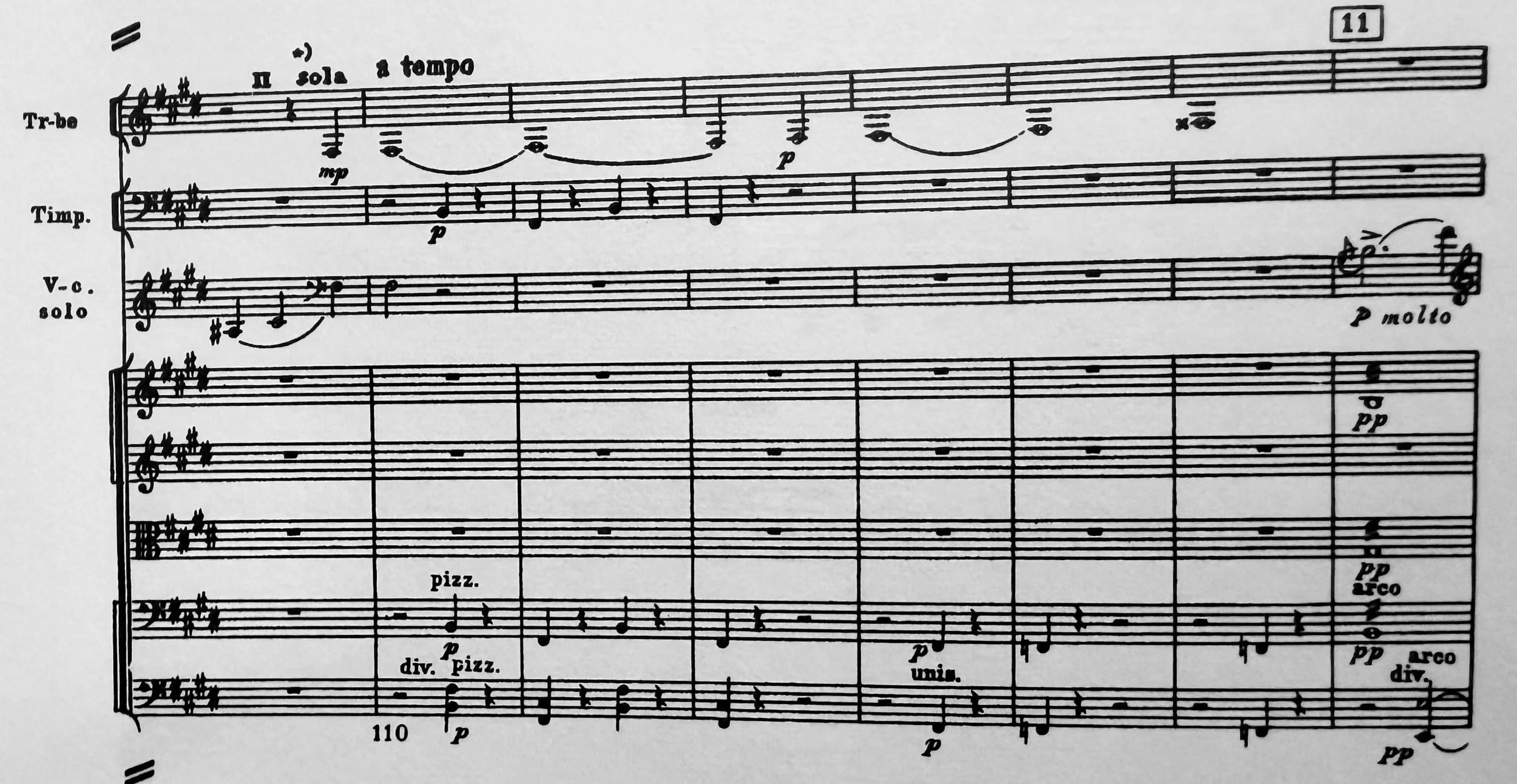
The same spot in the full score, before rehearsal 11: “II sola,” the solo cello in unison with my first note, pizzicato strings below, and a whole lot of empty staves.

And the footnote at the bottom of the score page.
Low, soft, and exposed notes on the trumpet can be a brutal combination. Low notes on the trumpet want to go flat, don’t always want to respond, and require me to be relaxed to play them with a great sound, and in time. Exposed means everybody can hear every one of those things happening.
What I actually did to get ready
It’s not magic. I did the unglamorous stuff, worked hard at it, and started early.
I basically lived in the low register in my practice room. My job in the section is 4th/Utility, which means I have to be ready for the high stuff and the low stuff on any given week. This particular week was all about the low stuff. For two or three weeks my daily routine basically shifted downward about an octave: long tones from low C on down, slow slurs through the bottom of the horn and into the pedal range, and a lot of time just playing low F#’s until they were comfortable.
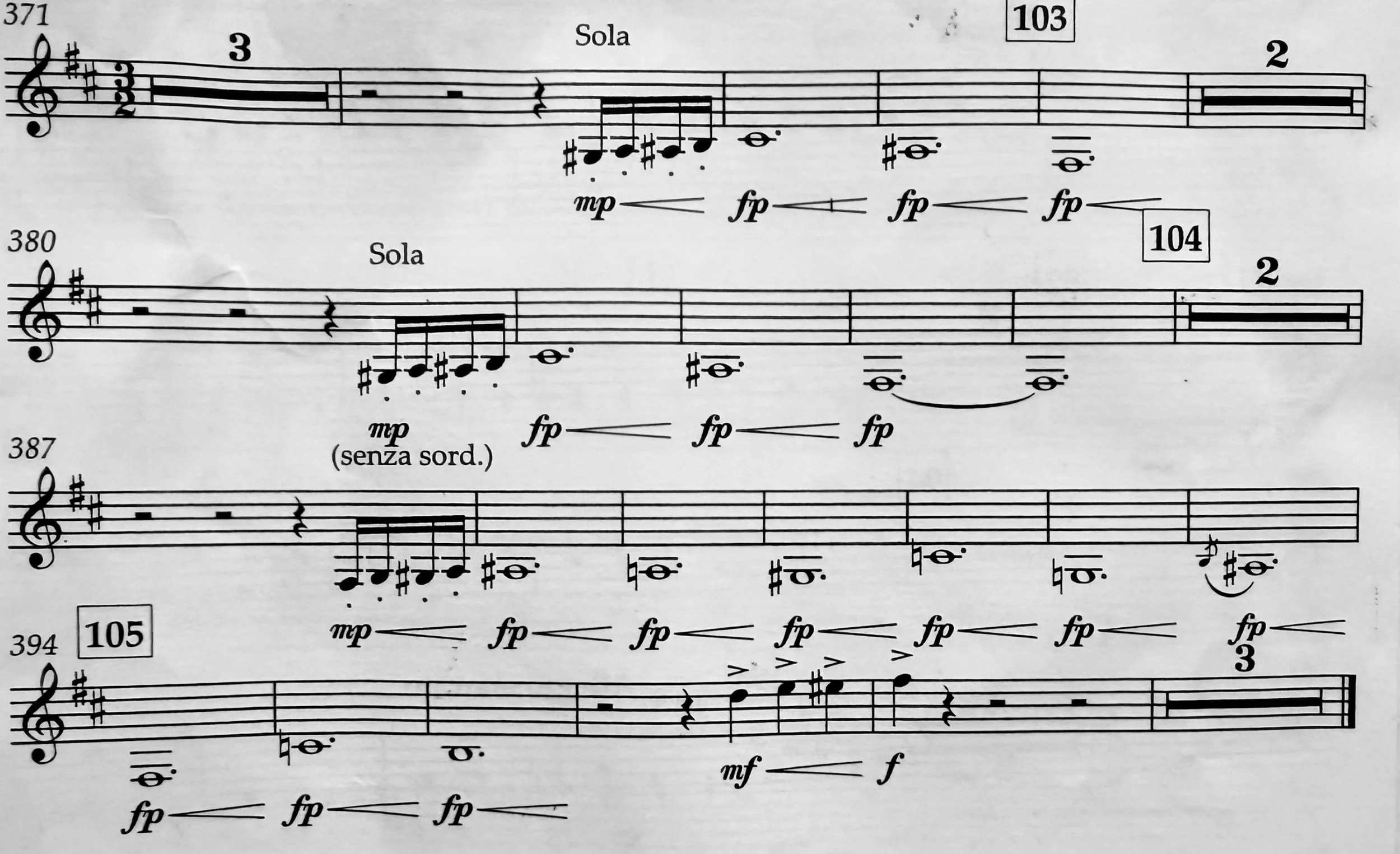
End of the third movement. Fast articulations followed by dotted whole notes (in octaves with the tuba!) at the very bottom of the horn, each one fp with a swell, and then a nearly two-octave jump up to finish.
I practiced the low notes softer than I'd probably need to ever play them. One of the things that I’ve always appreciated about the PSO Brass section is our range of dynamics and the extremes at which we play. Everyone knows about the loud dynamics, but we have to be able to play at the extreme softs as well, and in complete control. If I could make that second-movement soft low lick speak at a whisper in my practice room, my soft dynamic on stage would feel comfortable instead of feeling like walking on a tightrope. So, I tried to simulate the effect of making the practice room harder than the stage. Then the Heinz Hall stage felt normal.
I listened. There's a Pittsburgh Symphony recording of this piece from 1991 with Lorin Maazel and Yo-Yo Ma that I found fascinating: partly for the playing, partly because it's my own orchestra thirty-five years ago, in the same hall.
The equipment question
Students ask about gear constantly, so here’s my answer. After this past week, I think my answer is more interesting than usual.
I played the entire part on Bb trumpet, my New York Bach model 37. That's unusual for me. In the orchestra I'm on C trumpet 99% of the time. But the Prokofiev goes below the C trumpet's range too often, so my Bb made it onstage at Heinz Hall.
Then I used three different mouthpieces over the course of the piece:
My everyday mouthpiece: a Vennture copy of a Bach Corp. 1C, with a 24 throat and the Jeff Parke orchestral backbore (you can order it from them if you want - it’s a fantastic mouthpiece!). This is my home base mouthpiece.
A Schilke 20D2D, for the sections that were low and needed more volume at the bottom of the horn. I use it for low solos that need to have some “bark” to them.
A Schilke F1 for the second-movement solos. The F1 is a trumpet rim on a flugelhorn cup, and it gives me a dark, round low register sound. For a couple very soft low notes, I wanted it to be as comfortable as possible.
And one more piece of equipment: for that second-movement soft lick, I borrowed a felt hat from my colleague and played into it. I wanted that note to be really soft. It worked.
Here's the thing I want students to take from all this: the equipment helped at the margins. It did not do the work. A flugelhorn cup and a felt hat gave me a little extra softness and a little extra security. Three weeks of long tones are what made the lick sound like music instead of just notes. I like to use an analogy with students: a carpenter never goes to a job with just one screwdriver. He brings them all, because he doesn’t know what he might need. I could have played any of these licks on my normal Vennture mouthpiece… but why? A carpenter could probably get through almost all of the screws with one screwdriver, but he still uses the best tool for each job. It’s my job to always play with my best sound and have a wide palette of colors for any notes I need to play. I own over 100 mouthpieces because I want all of those colors available to me whenever I need them.
What this has to do with you
If you're a student reading this, you might have a part or a couple licks in front of you right now that might give you a little anxiety. A marching show closer. A PMEA etude. A solo for the spring festival.
Good! That's the right feeling, and it just means that you care. Here's what the Prokofiev piece last week reminded me:
Start earlier than you think you need to. Three weeks felt like a lot when I started. But I was very prepared, and the performances went well.
Practice the hard spots more than everything else, but be ready for all of it because it all needs to sound good.
Figure out what the passage actually needs: Low? Soft? Both? And build your practice around sounding your very best. Don't just "practice." Practice for something. Get to the point where you are confident enough to execute the lick onstage under any condition.
And know that the people you look up to are doing exactly this. Every week. On parts you'll never hear about.
All of my licks went well this weekend. As I tell my wife (just about!) every week, “I was clean.” The mouthpiece choices and the hat on the bell worked. And on Sunday afternoon I packed up the Bb trumpet and brought it home to my studio. It’s back on the trumpet stand for demonstrating in lessons, which is probably where it’ll stay until the next time Prokofiev decides to pick on the second trumpet. In all honesty, though, he’s written some of the best second trumpet parts in the entire repertoire.
These are the kind of real-world experiences I feel obligated (and blessed!) to share with students. If your student has a part that's scaring them a little, that's exactly what we work on. The first lesson is free.
Chad Winkler has been a member of the Pittsburgh Symphony Orchestra trumpet section for 20 seasons and teaches private trumpet lessons in Mt. Lebanon.
